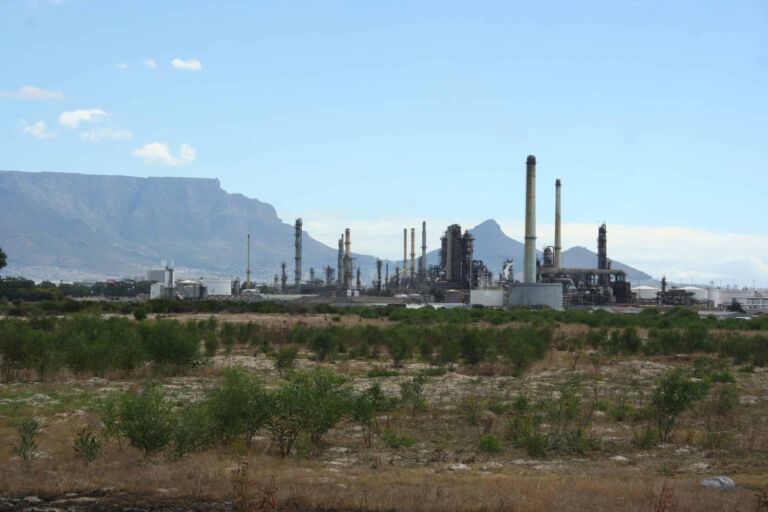

Few promises carry as much political appeal in South Africa as the prospect of cheaper petrol. Every hike at the pump ripples directly through households, businesses, and the transport sector.
Against that backdrop, rebuilding the country’s domestic refining capacity sounds like a straightforward route to relief. Yet the underlying economics are far more complicated, raising tough questions about supply resilience and industrial policy that cannot be brushed aside.
Start with the popular assumption that refining fuel on South African soil will automatically lower prices at the pump. That claim cannot go unchallenged.
Because South Africa’s petrol price is regulated, what motorists actually pay is a composite of international market benchmarks, the rand’s exchange rate, taxes and levies, transport costs, and wholesale and retail margins. A local refinery’s operating costs are only one piece of a much larger puzzle.
Even if a commercially efficient plant managed to produce fuel below the prevailing international benchmark, whether motorists ever see that saving depends entirely on market competition and the regulatory pricing framework.
Conversely, an expensive refinery propped up by subsidies or protective tariffs would simply shift the financial burden elsewhere in the economy. Any serious proposal must therefore offer a transparent accounting of who pays, who benefits, and how.
The realities of the global refining industry make the challenge steeper still. Today’s market is dominated by massive, highly sophisticated facilities that process crude oil at immense scale. By contrast, many of South Africa’s plants are smaller and ageing.
Bringing a shuttered facility back to life—or upgrading an existing one—means confronting deteriorated equipment, constrained sites, the heavy cost of meeting modern fuel specifications, and, in KwaZulu-Natal’s case, lingering flood damage. Since every facility faces its own distinct hurdles, a credible assessment requires plant-by-plant evidence rather than a sweeping national verdict.
Building a brand-new refinery is no simpler. Soaring construction costs and the price of finance ultimately determine whether a local project can compete with imported fuel. South Africa’s perceived country risk already drives up the cost of capital, and construction delays can quickly erode whatever returns remain.
Nor is the regional market a guaranteed saviour: it is far from clear that demand across southern Africa is large enough to justify a world-scale plant, especially given that neighbouring countries have already turned to alternative suppliers when South African supply proved unreliable in the past.
Then there is the question of tomorrow’s demand. Over the multi-decade lifespan of a refinery, electric vehicles and shifting transport technologies could reshape fuel consumption.
How quickly that transition will unfold in South Africa remains uncertain, as does the future balance between petrol, diesel, and other refined products. Before committing capital, investors and taxpayers alike deserve rigorous modelling that stress-tests both a rapid transition and a slower one.
Separating attractive political promises from demonstrable savings also means questioning what "energy independence" really looks like.
A local refinery running on imported crude is still exposed to global oil prices, currency swings, and shipping disruptions. Even if commercial quantities of oil were discovered locally, the producer would likely seek the best international price rather than hand South Africans a hometown discount.
In truth, crude imports and finished-fuel imports simply carry different sets of vulnerabilities across shipping, port capacity, storage, plant reliability, and inland distribution. A domestic refinery can break down just as easily as an import terminal can be disrupted.
The real question is what mix of local capacity, diversified suppliers, storage, and logistics can keep fuel flowing at an acceptable cost—even if comparing those options in detail, or putting a precise price tag on a supply interruption, remains difficult.
History also warns that public megaprojects carry a high risk of delays and cost overruns. Worse, a narrow fixation on state-backed refining can crowd out more pragmatic alternatives, such as carefully structured partnerships, strategic reserves, or targeted public investment. Any public intervention should be held to the same strict cost-benefit scrutiny as a private project.
The same standard of proof should apply to claims about jobs and the wider economy. While a refinery undoubtedly supports skilled workers, suppliers, and linked industries, importing fuel also sustains jobs and infrastructure.
Measuring the true economic benefit of local refining requires accounting for the cost of imported crude, specialised equipment, and financing. And because importing crude and importing finished fuel both expose the country to exchange-rate risk, the net foreign-exchange benefit of local refining is something to be calculated, not merely asserted.
A final, delicate trade-off sits right on the forecourt. South Africa’s current pricing structure protects retail margins that sustain forecourt jobs and smaller independent service stations. Introducing greater competition might sharpen efficiency, but any reform has to reckon with the workers and communities whose livelihoods depend on the existing system.
So far, there is little clarity on how to manage that transition—or which incremental reforms would deliver the biggest gains with the least disruption.
What South Africa needs now is an open, side-by-side assessment that weighs refinery proposals against investments in import capacity, storage, and distribution. That process should lay its cards on the table by publishing the underlying assumptions on costs, future demand, emissions, employment, regional markets, and security of supply.
Cheaper fuel and stronger resilience are goals worth pursuing, but reaching them will take hard evidence, honest trade-offs, and a willingness to compare every practical option before us.